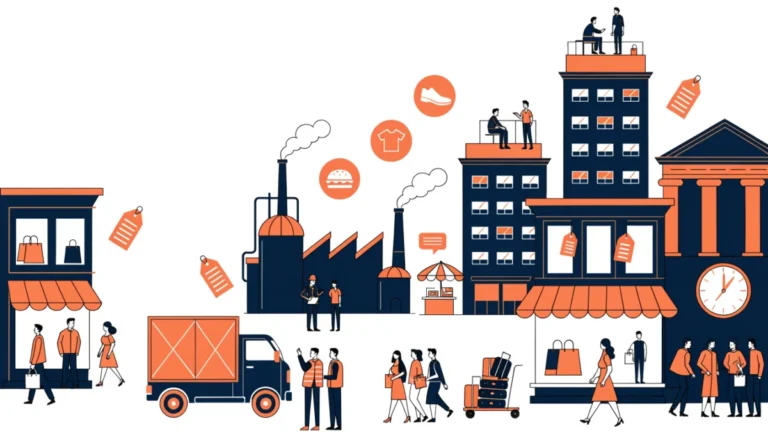

A market economy is one where prices, production and wages are set mainly by supply and demand rather than by the government. Its main characteristics are private property, freedom of enterprise and choice, the profit motive, the price mechanism, competition, consumer sovereignty and a limited role for the state.
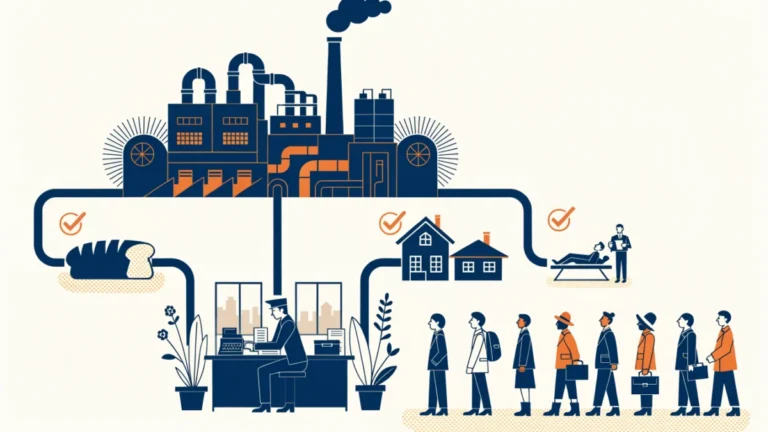
In a market economy, the key questions of what to produce, how to produce it and who gets it are answered by millions of buyers and sellers acting in their own interest. Governments still make laws, enforce contracts and provide some public services, but they do not plan output or fix most prices.
7 Key Characteristics of a Market Economy
1. Private Property
Individuals and companies own land, factories and other resources and can buy, sell or use them as they choose.
2. Freedom of Enterprise and Choice
Anyone can start a business, choose an occupation and decide what to buy. Firms decide what to make and how.
3. Profit Motive
Businesses produce goods because they expect to earn a profit. Profit rewards efficiency and risk-taking; losses push resources elsewhere.
4. Price Mechanism
Prices rise when demand exceeds supply and fall when supply exceeds demand. These price signals tell producers what to make more or less of.
5. Competition
Many firms compete for customers, which keeps prices in check and pushes quality and innovation.
6. Consumer Sovereignty
Consumers decide what succeeds. Products that people do not buy disappear, however much the producer likes them.
7. Limited Role of Government
The state protects property, enforces contracts, keeps order and regulates where needed, but does not plan the economy.
Market Economy vs Planned Economy
| Basis | Market economy | Planned (command) economy |
|---|---|---|
| Who decides | Buyers and sellers | Central government |
| Ownership | Mostly private | Mostly state |
| Prices | Set by supply and demand | Fixed by the state |
| Motive | Profit | Social goals and plan targets |
| Strength | Efficiency, innovation, choice | Equality, control of priorities |
| Weakness | Inequality, booms and busts | Shortages, waste, little choice |
In practice no country is a pure market economy. The United States, the United Kingdom, Singapore and Japan lean strongly towards markets, while India is a mixed economy that combines private enterprise with an active public sector.
What Does “Market” Mean in Economics?
A market itself is not a place but an arrangement in which buyers and sellers of a commodity are in close enough contact to settle a price. Economists describe a market by five elements: an area (local, national or global), buyers and sellers, one commodity, competition between them and, in a perfect market, one price for the same good.
Advantages and Drawbacks
Advantages: efficient use of resources, wide consumer choice, rewards for effort and innovation, and fast response to changing tastes.
Drawbacks: unequal incomes, neglect of public goods such as roads and clean air, monopolies if competition fails, and periodic recessions. This is why most economies add government regulation and welfare to the market system.