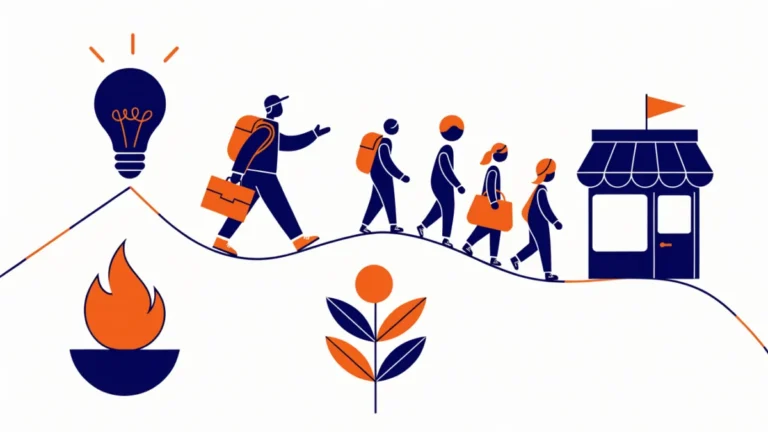
The objectives of Entrepreneurship Development Programmes are to create first-generation entrepreneurs, build the entrepreneurial mindset, help identify opportunities, teach project report preparation, explain finance sources and government schemes, build management skills, promote self-employment, support small and rural industry, encourage balanced regional development and provide follow-up support.
An Entrepreneurship Development Programme (EDP) is a structured course that helps people start and run their own businesses. It covers the skills a first-time founder usually lacks: spotting an opportunity, writing a project report, raising a loan, handling accounts and finding customers.
India was an early adopter. The Gujarat Industrial Investment Corporation ran some of the first EDPs in the early 1970s, and in 1983 the Entrepreneurship Development Institute of India (EDII) was set up in Ahmedabad with backing from IDBI, IFCI, ICICI, SBI and the Gujarat government. Today, MSME Development and Facilitation Offices, NIESBUD, NI-MSME, state agencies and banks’ rural self-employment training institutes (RSETIs) run EDPs across the country.
10 Objectives of EDPs
1. Create First-Generation Entrepreneurs
Most Indian businesses were historically run by trading families. EDPs aim to bring people from outside those communities into business: graduates, women, rural youth and people from SC/ST backgrounds.
2. Build the Entrepreneurial Mindset
Training targets traits such as the need for achievement, initiative and willingness to take calculated risks, drawing on David McClelland’s achievement-motivation work, which was tested in Kakinada, Andhra Pradesh, in the 1960s.
3. Help Identify Business Opportunities
Participants learn to scan local markets and spot gaps. See our guide to identifying business opportunities.
4. Teach Project Report Preparation
Banks want a bankable project report before lending. EDPs teach participants to estimate costs, sales, break-even and cash flow.
5. Explain Sources of Finance and Government Schemes
Participants learn about MUDRA loans, PMEGP subsidies, Stand-Up India, CGTMSE guarantees and Startup India benefits.
6. Build Basic Management Skills
Accounts, GST compliance, inventory, hiring and marketing are covered so the new owner can run day-to-day operations.
7. Promote Self-Employment
EDPs turn job seekers into job creators, which matters in a country where millions join the workforce every year.
8. Support Small and Rural Industry
Programmes focus on micro and small units, crafts and agro-processing, spreading industry beyond big cities.
9. Encourage Balanced Regional Development
Running EDPs in backward districts helps spread enterprise to areas with few existing businesses.
10. Provide Follow-Up Support
Good EDPs do not stop at the classroom. They help with loan applications, licences and mentoring in the first year, when most new businesses struggle.
Who Runs EDPs in India
| Institution | Role |
|---|---|
| EDII, Ahmedabad (1983) | National resource institute for entrepreneurship training and research |
| NIESBUD, Noida | Trains trainers and runs EDPs under the Ministry of Skill Development |
| NI-MSME, Hyderabad | Training and consultancy for micro, small and medium enterprises |
| MSME-DFOs | Run ESDPs (entrepreneurship and skill development programmes) in states |
| RSETIs | Bank-sponsored rural self-employment training in most districts |
For how these programmes are structured, see the phases of an EDP and the types of EDPs.